
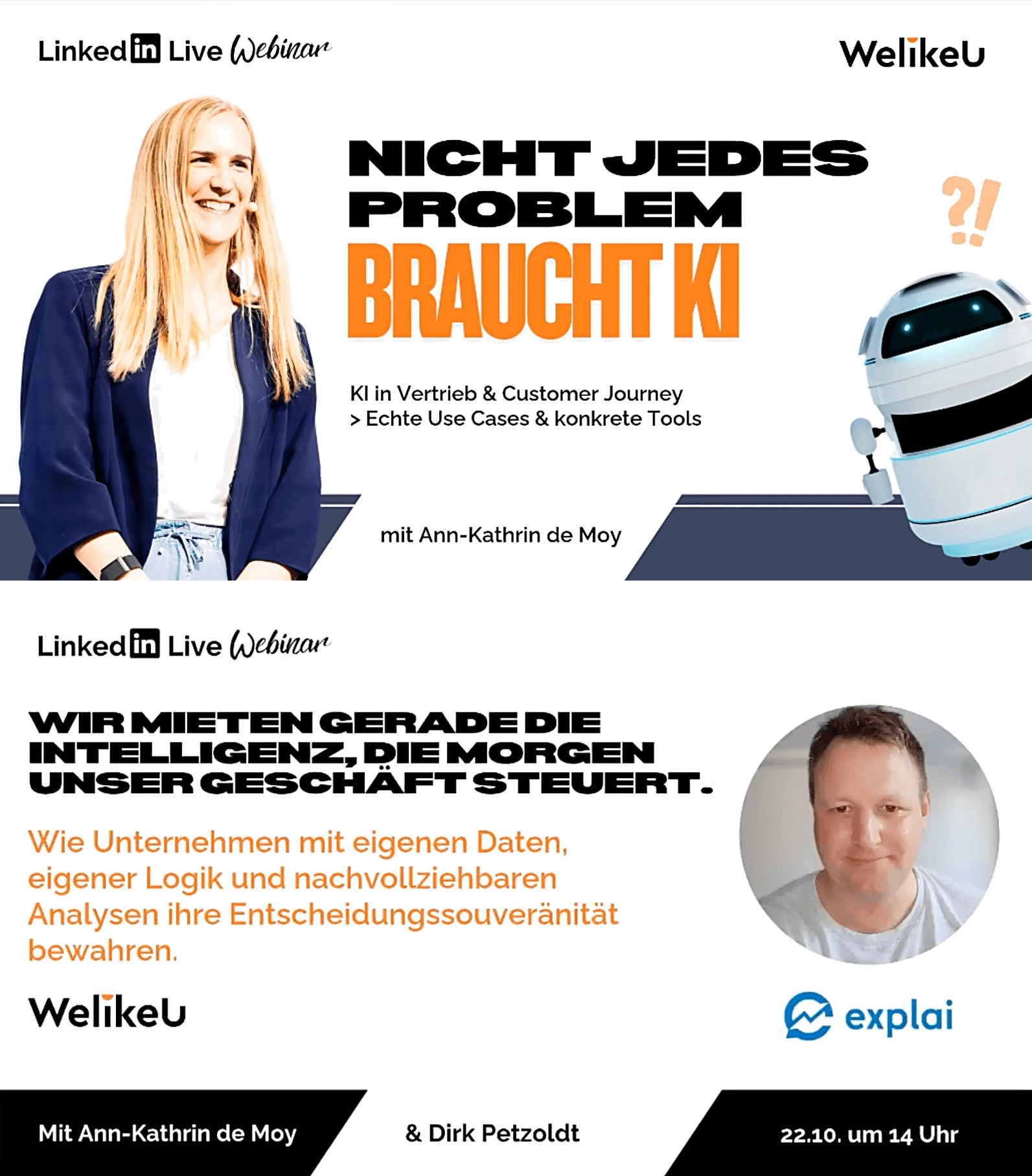
Exactly one month ago, Ann-Kathrin de Moy of WelikeU talked with Dirk Petzoldt in a LinkedIn Live webinar about a question on the minds of many executives, IT teams and data protection officers: We are renting the intelligence that will run our business tomorrow. Who stays in control?
It's about far more than where the servers are: data, models, infrastructure, and your own know-how in using them. Here are the key ideas, with sources and current examples. You'll find the full recording (60 minutes, in German) at the end of this post.
- AI sovereignty means you stay in control of your data, can switch providers, and can check what happens to your data at any time. For mid-sized companies, this is achievable today with reasonable effort.
- The more private the data, the more control it needs. Sensitive tasks belong on models under your own or European control; uncritical ones can go to a frontier model.
- A data center in the EU is not enough. What matters is which law the provider is subject to.
- Agents act with employees' permissions. The rules, tests and logs that govern their behavior belong in-house.
- The big providers keep changing prices and terms. Companies with their own test questions and documented knowledge can switch models.
The more private the data, the more control matters
In the webinar, Dirk illustrated this with three analyses produced by an explai data agent. With each example, the data gets more confidential, the analysis more valuable, and control more important. You can try the data agent for free in the explai Sandbox.
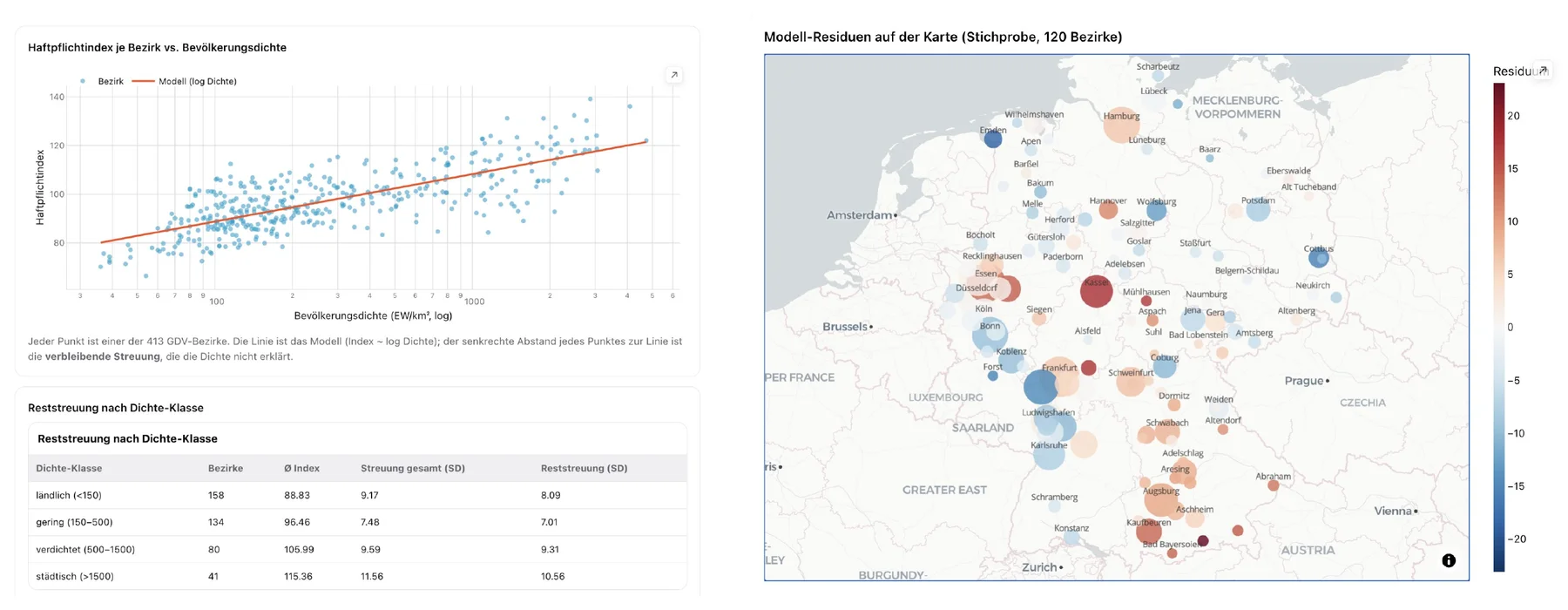
Market data. How strongly does the liability index across the 413 districts of the German insurance association GDV depend on population density, and which districts stand out? The data is public. A closed frontier model can do this one.
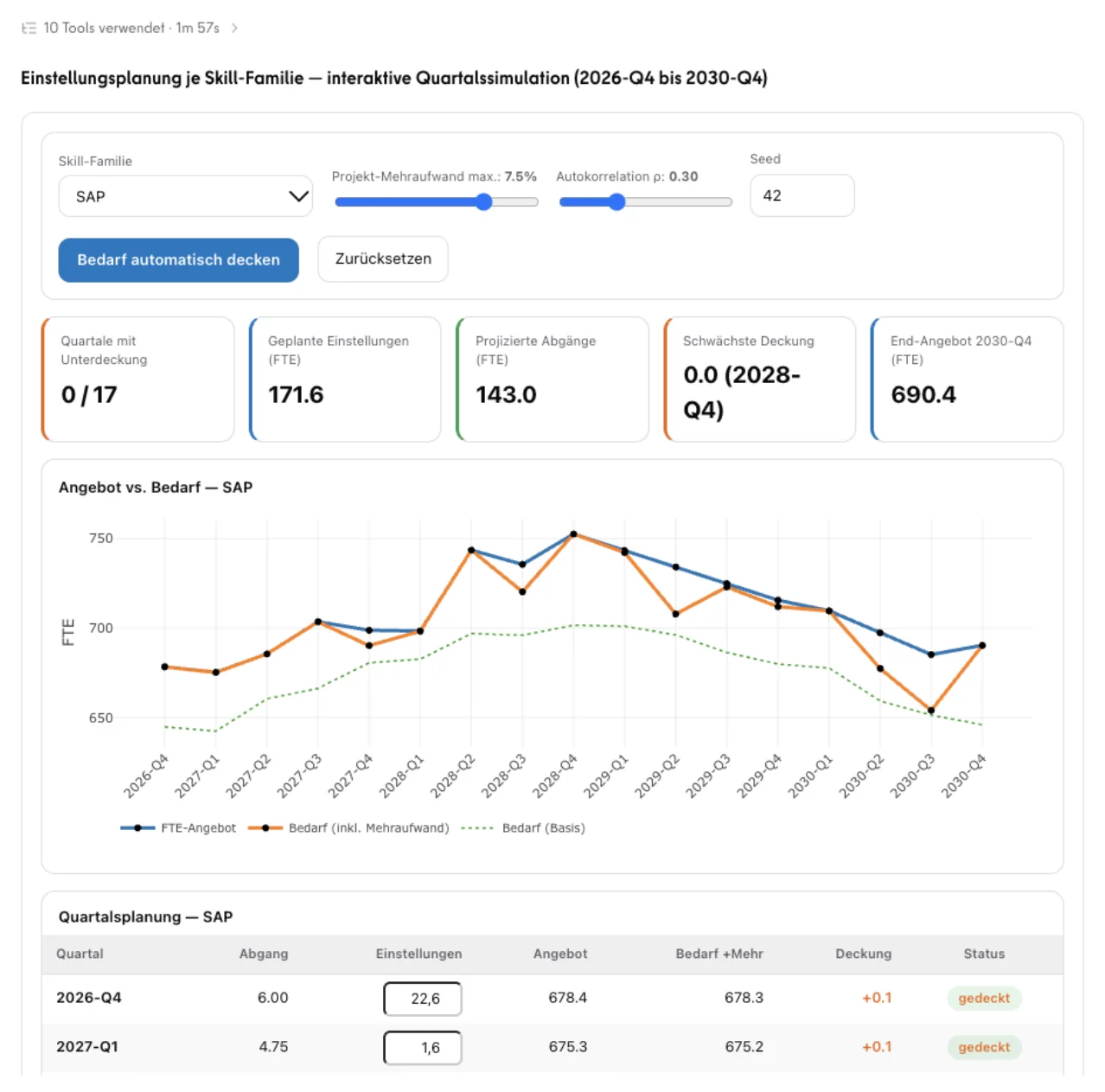
Project and employee data. How many SAP specialists will the company need through 2030 if projects take more effort and employees leave? The agent builds an interactive staffing plan in which the assumptions can be adjusted. Staff and project data are internal and sensitive. They belong on a model under your own or European control.
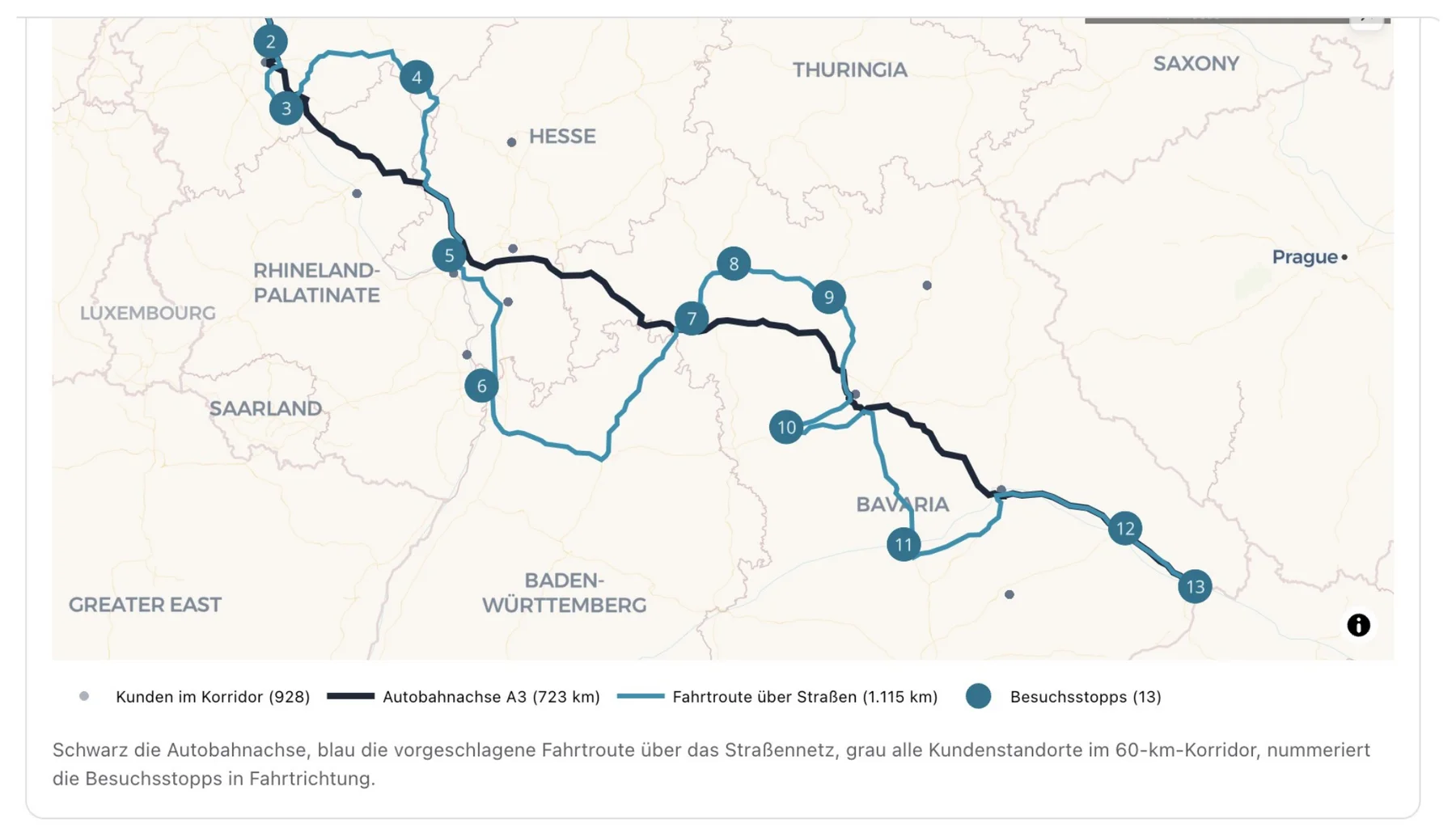
Customer data. Which customers are located along the A3 motorway, and which route connects 13 visits sensibly? The agent picks the stops from 928 customer locations in the corridor and plans the trip over the road network. Customer addresses are personal and business-critical. At this point at the latest, no record should leave the company uncontrolled.
Most companies don't know which AI their people use
According to Netskope's Cloud and Threat Report 2026, almost half of generative AI users (47%) use personal accounts rather than the ones their company has approved. Personal licenses usually come with weaker legal commitments than business contracts. Dirk's question back in the webinar: would you give a competitor access to your pricing database? That is effectively what can happen when customer data ends up in a personal chatbot.
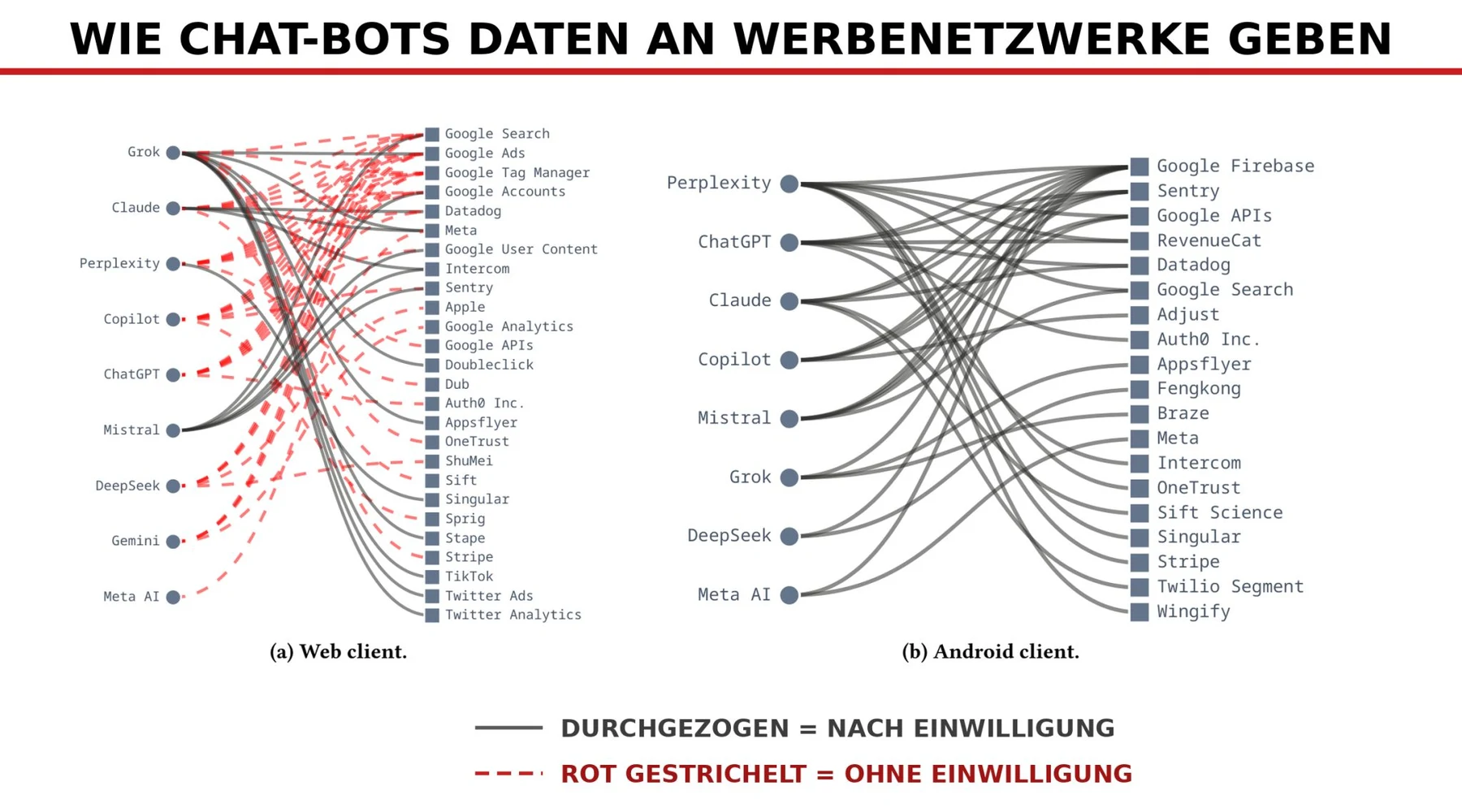
Then there is what the chatbots themselves pass on. Researchers at IMDEA Networks examined the web and Android apps of nine well-known AI chatbots (Oliveira et al., 2026, not yet peer-reviewed). All of them embed advertising or tracking services, 44 third parties in total. Several providers share chat titles, prompts or screenshots with third parties, often together with persistent user identifiers. Even when users reject all non-essential cookies, 80.8% of trackers stay active. Whether the account is free or paid makes little difference.
A data center in Frankfurt is not enough
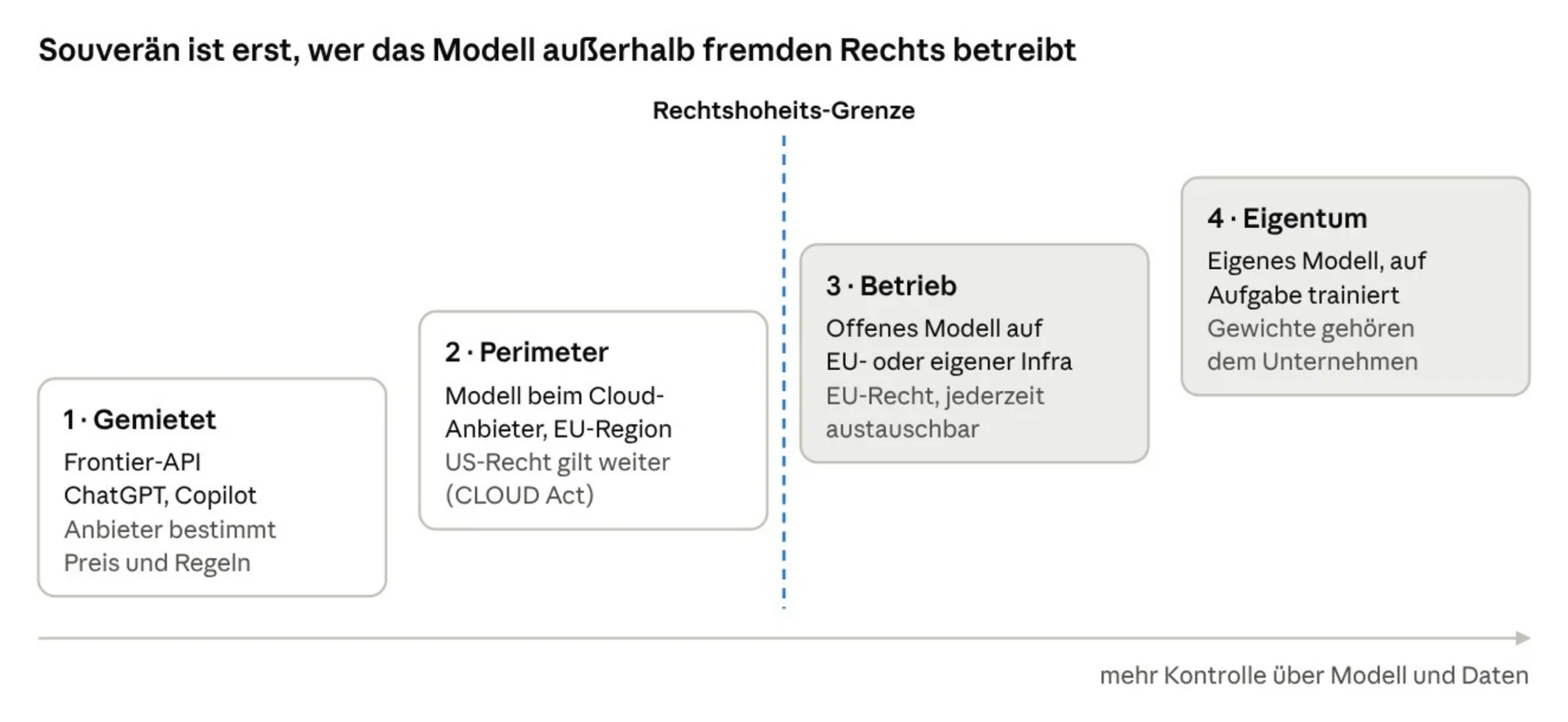
What matters is who controls the data, not where the disk sits. A US provider, even through its EU subsidiary, remains subject to US law:
- CLOUD Act (2018): US authorities can compel US companies to hand over data, even if it is stored in Europe.
- FISA Section 702: allows intelligence agencies to access data of non-US persons held by US providers. This was the core of the European Court of Justice's Schrems II ruling.
- On the record: in June 2025, Microsoft France's head of legal affairs was asked under oath before the French Senate whether he could guarantee that French citizens' data would never be passed to the US government without the French authorities' consent. His answer: no, he could not guarantee it.
Genuine European jurisdiction shows in five points: the provider is EU-controlled. The customer or an EU trustee holds the keys, so the provider is technically unable to hand anything over. Administration and support are handled by EU staff only. The entire chain of subprocessors is EU-based, including monitoring and backups. And there is no kill switch from outside, for example through licenses or updates.
"We're only typing in a prompt"
What employees type is only a small part of what reaches the model. The software automatically enriches every question with documents, chat history, tool results and files. Users see their question, not the context behind it. That context is often larger and more sensitive than necessary, and the provider logs it.
Two more points from the webinar:
- Tools can carry data outside, even when the model runs locally. To produce a single answer, a model often calls dozens of tools behind the scenes, such as web search. It writes the search queries from confidential context, with customer, project or product names, and sends them to third parties, outside the contract with the model provider.
- "We don't train on your data" usually covers content only. The commitments apply to prompts and answers. Metadata, feedback, usage patterns and logs are often not covered, and agent traces are rarely named explicitly. The terms are worth reading, for example those of OpenAI, Anthropic or Google.
Agents need more control than chatbots
Chat was the entry point; agents are now gaining ground, whether visible or built into software. According to Bitkom, 11% of German companies that use or plan to use AI already run agents. Agents don't just answer, they act: they send emails, make bookings and change files, over many steps and with employees' permissions.
The risk grows when access to internal data, outside content and external channels come together. One example is EchoLeak, a vulnerability in Microsoft 365 Copilot discovered in 2025: a crafted email was enough to leak confidential data, without anyone clicking anything. Microsoft has since fixed it (CSO Online).
With traditional software, control is mostly about data and access. With AI, control over behavior comes on top, because the system can change without any change to the code. What a company should hold in its own hands:
- Rules and guardrails: the company decides which instructions the system gets and what it must not do, and documents every change.
- Least privilege and approvals: an agent only sees the data and takes the actions its task requires. It is clear where a human has to sign off.
- Traceability: every action can be reconstructed with its inputs, context and model version.
- Limits: cost and actions are capped, and there is an emergency stop.
A sensible minimum rule: personal data is detected and removed before anything leaves the company.
When a tool becomes a dependency
AI is becoming a utility like electricity or water. The guiding question for every leadership team: what happens if your AI provider triples its price tomorrow, or switches you off? According to Bitkom, 73% of German companies now worry about dependence on US technology, up from 38% in 2024.
Examples from this year:
- Prices: Google is doubling the price of Gemini 3.8 Flash and other Flash models on January 1, 2027 (Google).
- Shutdowns: even current models are retired or automatically replaced by another model less than 18 months after release (deprecation lists from OpenAI, Anthropic and Google).
- Ads: since February 2026, ChatGPT has shown ads in its free and low-cost plans, in the US for now (heise).
The writer Cory Doctorow coined a term for this: "enshittification", a service gradually getting worse or more expensive once its customers depend on it. Anyone who has tailored their instructions and workflows to exactly one model or platform then has to rebuild under time pressure. The Data Act offers some relief: from January 12, 2027, cloud providers may no longer charge switching fees (Bundesnetzagentur). It lowers the cost of switching, not the effort of moving instructions and tests to a new model.
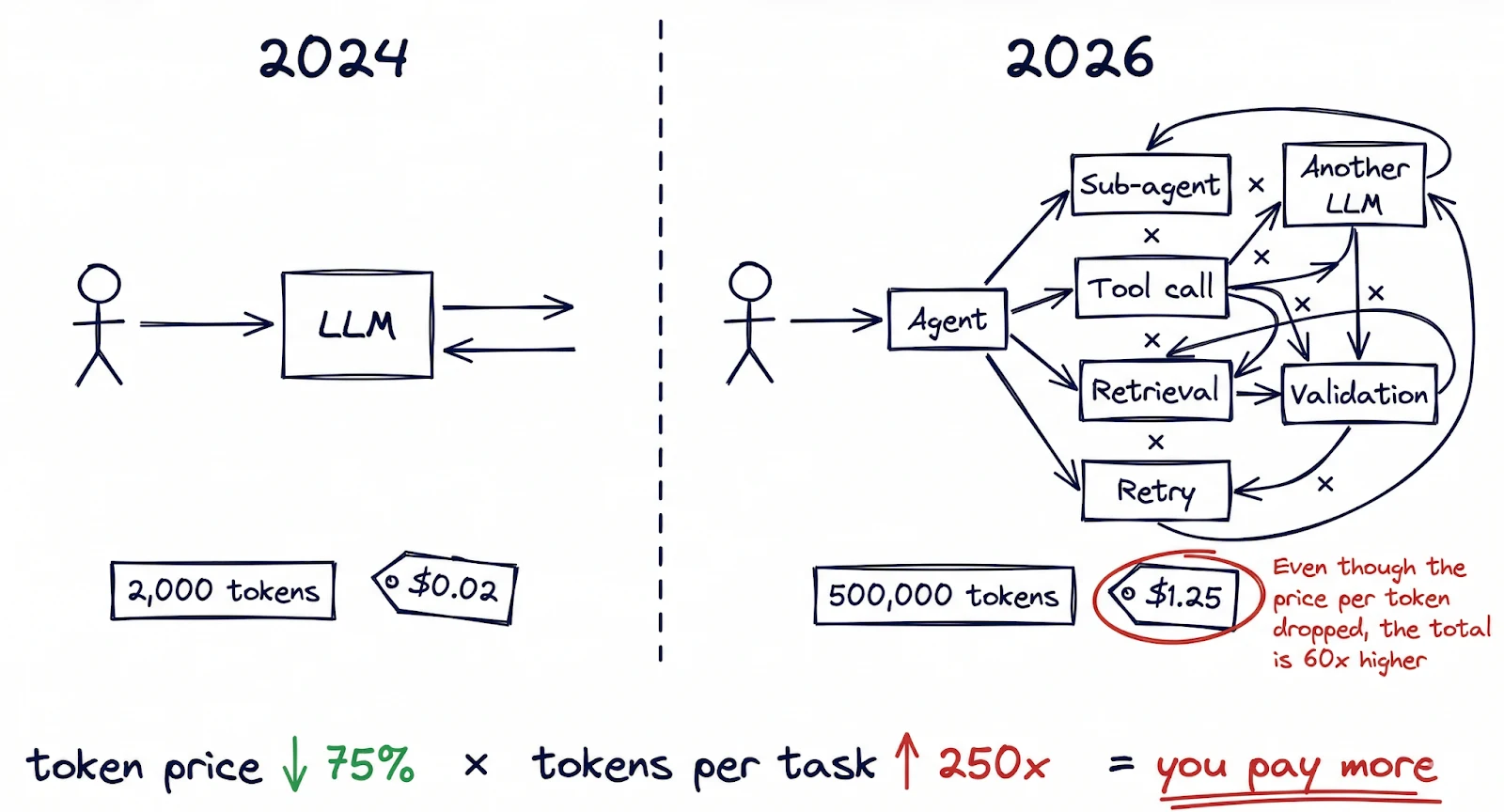
On price, too, the obvious metric is misleading. Providers bill in tokens, roughly one syllable per token, and the price per token is falling fast. The investor Andreessen Horowitz calls this "LLMflation". Bills still go up, because for a single task an agent calls sub-agents, tools and other models and consumes many times more tokens (Artefact). What matters is the cost per completed task. In Artificial Analysis's tests, a task cost 4 cents with the open model DeepSeek V4 Pro and 20 to 45 times as much with leading closed models (June 2026). In the end, what counts is what AI contributes to the business, and only companies with their own tests can measure that.
Open models and hybrid operation
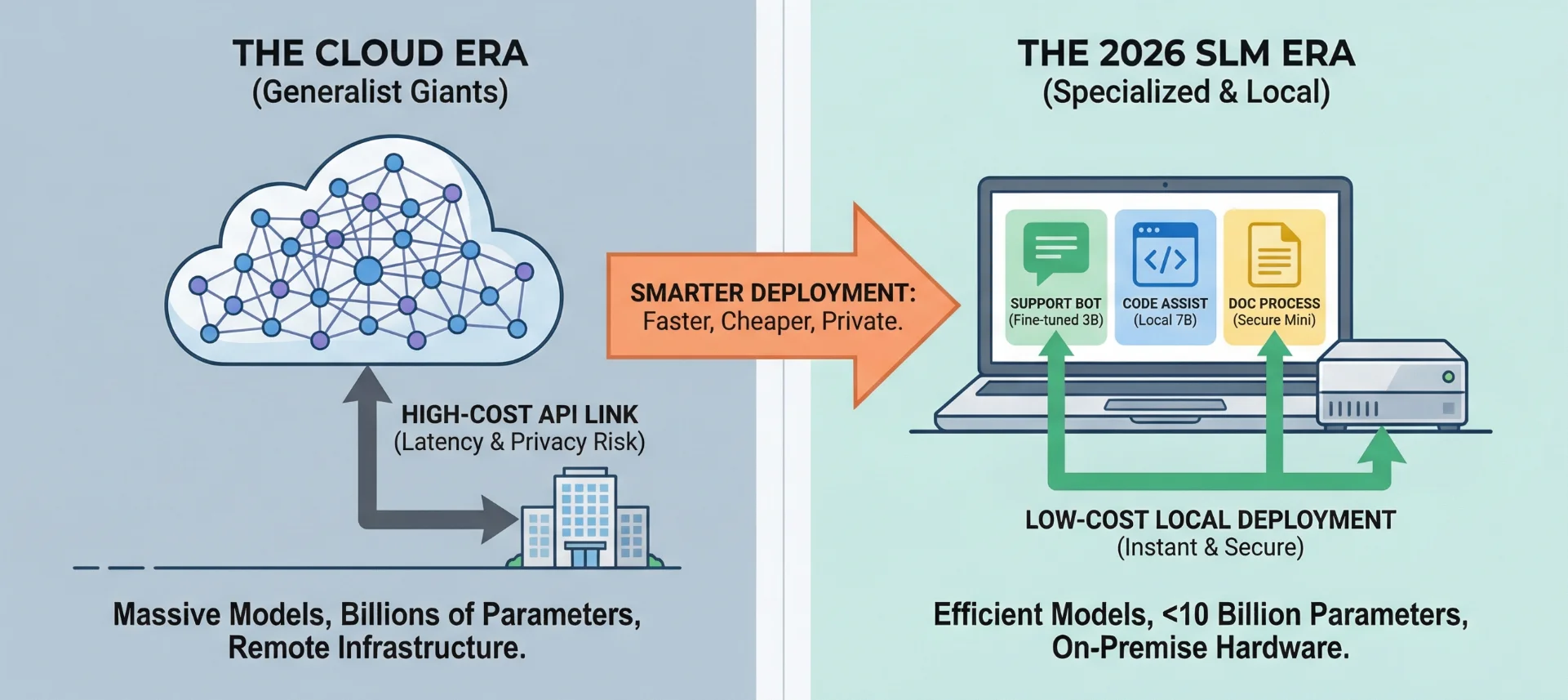
The gap between open and closed models has shrunk to a few months. For standard tasks such as search, summarization and extraction, open models like gpt-oss, Mistral or Qwen are often good enough. For narrowly defined tasks there are small specialized models that can even outperform large ones. NVIDIA researchers go as far as saying small language models "are therefore the future of agentic AI": for many of the steps an agent performs, they are powerful enough, better suited and more economical (Belcak et al., 2025). In our own test on LiveBench's 150 data analysis questions, an open model scored within the margin of error of Claude Opus 5, at a tenth of the cost per correct answer (read the post).
What about Chinese models like Qwen or DeepSeek? If you download such a model and run it on your own machines, no data goes to China. Avoid the makers' own apps and APIs, though. Your own test questions will show whether the model answers one-sidedly on certain topics.
So sovereignty doesn't mean running everything yourself. A sovereign setup routes the work: sensitive tasks run on models under your own or European control, for example on your own machines or with a European cloud provider. Uncritical tasks such as competitor research can go to a closed frontier model. This requires a provider that lets you choose the language model freely.
Where to start
- Choose a provider that keeps all options open and offers full transparency into how its agents behave. For a pilot with limited data access, the provider's cloud is an affordable, fast way to start, as long as moving later and exporting all data remain possible.
- Build your own test questions with verified answers. Measure every model and every update against them. Only then does switching models become a decision rather than a risk.
- Capture your own knowledge: terms, rules, metric definitions and hands-on experience, documented and stored independently of any model. The knowledge stays in the company, the model becomes replaceable.
- Log everything: every request with its context, every tool call, every answer, in your own system. This makes audits under the AI Act and GDPR possible, and the system learns, because corrections flow back into knowledge and tests.
The key idea
Our knowledge and our data are our competitive advantage. They determine how useful AI is to us. In our private lives, we gave them away to the big platforms. We should not repeat that mistake in business.
The recording
Watch the full conversation here, or on YouTube and on LinkedIn.
Where does your company stand today? Let's find out in a 30-minute conversation. Get in touch.
Further reading
- BSI guidance on AI: recommendations from Germany's Federal Office for Information Security on using AI securely.
- The AI Act at a glance: what the EU's AI regulation requires of companies.
- Data Act switching charges: how the Bundesnetzagentur explains the end of fees for switching cloud providers.
- Open models put to the test: our comparison of open and closed models on 150 data analysis questions.