
The World Bank and the OECD publish lists of fragile states. Those lists influence where aid goes, which economies get help stabilising and where conflict prevention focuses. Banks are stress-tested for fragility, supply chains are analysed for it, and so are ecosystems and health systems. The word is everywhere. A shared definition of it is not.
EconAI is a research group of economists and data scientists working on armed conflict, economic crises, political instability, development and climate change at the meeting point of economics and machine learning. It is led by Laura Mayoral, Hannes Mueller and Christopher Rauh, all three researchers at the Institute for Economic Analysis (IAE-CSIC) and the Barcelona School of Economics. Rauh is also a professor at the University of Cambridge. Mueller and Rauh also run conflictforecast.org, which publishes forecasts of armed conflict.
In a new working paper, Joan Margalef, Laura Mayoral, Hannes Mueller and Christopher Rauh propose a general framework for measuring fragility. EconAI will use explai to apply it to real data.
Fragility is the ease of failure
The framework starts with a strict definition: fragility is the ease with which an object fails, where failure is a clearly specified outcome. The object could be a bridge, a bank, a city or a state. In each case, fragility only makes sense once you know which failure you mean.
That separates fragility from two concepts it is often confused with. Risk combines the probability of failure with the severity of its consequences, so fragility is one component of risk. Resilience is the capacity to recover. A system can be fragile and still recover quickly, or robust but slow to recover.
The paper models failure as a stress–damage process. An object with given characteristics is exposed to stress, such as a drought, a debt shock or political polarisation. External factors, such as central bank interventions or international assistance, shape how that stress turns into damage. Once damage crosses a threshold, the object has failed.
Five measures, one trade-off
From this model the authors derive five types of fragility measures:
- Critical stress: the lowest level of stress that causes failure.
- Damage condition: whether a given level of stress causes failure, as in a bank stress test.
- Conditional probability: the likelihood of failure at a given stress level, as in the fragility curves of seismic engineering.
- Unconditional probability: the overall likelihood of failure, for example the probability of a banking crisis estimated from history.
- Composite index: an aggregate of indicators believed to track the ease of failure, like most state-fragility rankings.
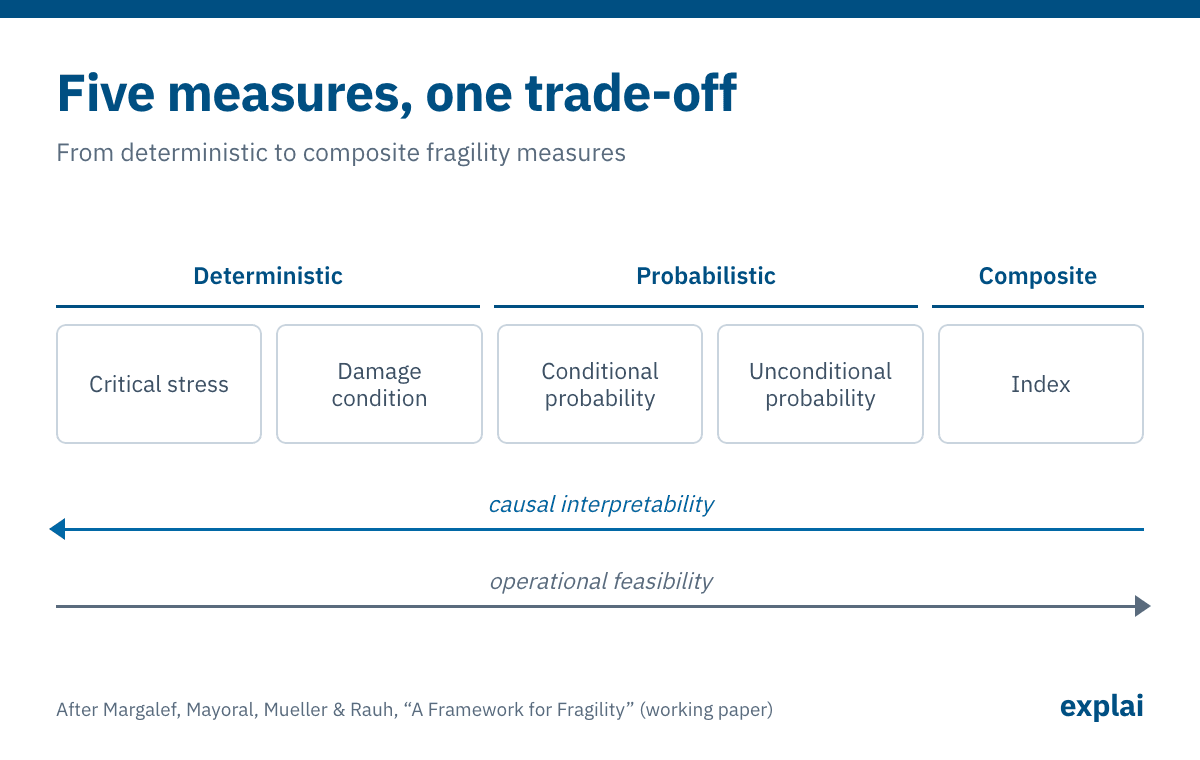
Moving from deterministic to probabilistic to composite measures, the measures become easier to construct and explain less about why failure happens. Composite indices can be built even when failures are rare, but if one country scores 2 and another 4, it is unclear what those two points mean in practice.
The choice of measure also changes the answer. The paper gives a stylised example. Suppose a building in Japan collapses with probability 0.3 during an earthquake and earthquakes occur with probability 0.2. In Spain the collapse probability during an earthquake is 0.6, but earthquakes occur with probability 0.05. Given an earthquake, the Spanish building is twice as fragile. Unconditionally, it is half as fragile: 0.03 against 0.06. Both statements are correct. Which one matters depends on whether you want to retrofit buildings or forecast collapses.
Define failure first
This leads to the paper's central point: the definition of failure drives everything else. The authors propose a five-step protocol for designing a fragility measure.
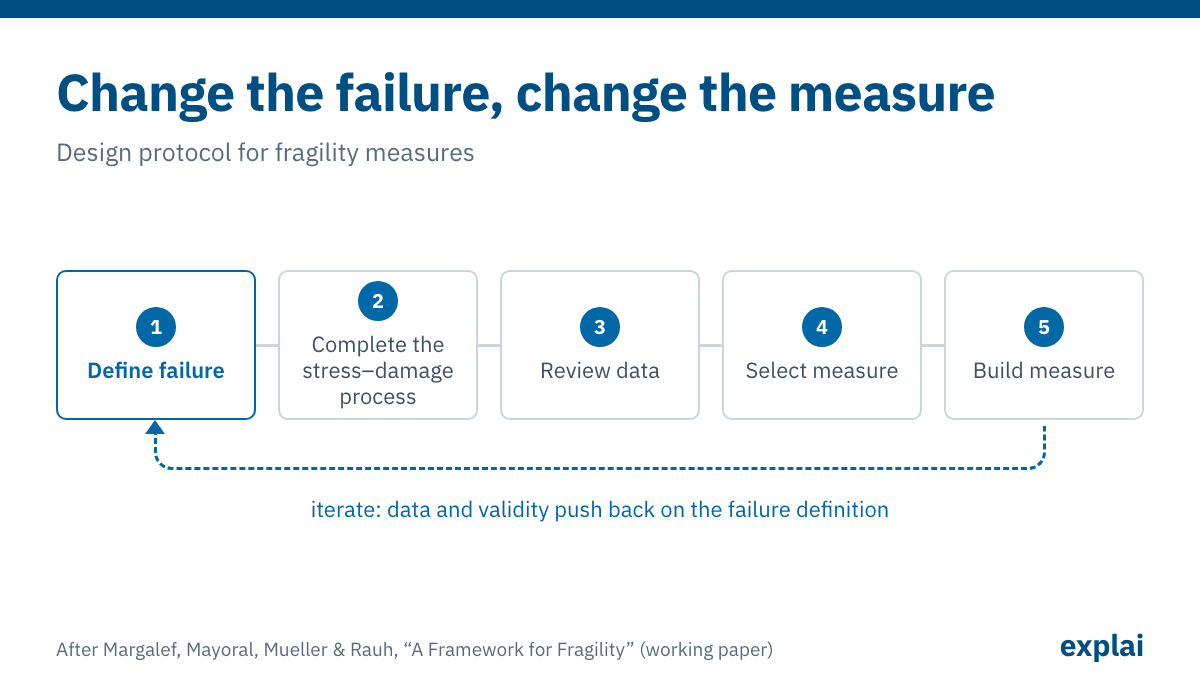
They apply it to a city reassessing its wildfire threat after the January 2025 fires in Southern California. If failure means a wildfire occurs in the municipality, the relevant inputs are drought indices, vegetation and sources of ignition, and prevention means vegetation management or fire bans. If failure means at least one home is destroyed, the analysis moves to building materials, urban layout and fireline intensity, and prevention means fire-resistant construction and retrofitting. A small change in definition leads to different data, different estimation methods and different departments in the city administration.
Research for a good cause
EconAI builds difficult models on questions that shape millions of lives: armed conflict, economic crises, poverty and climate risk. Forecasts of where crises are likely to emerge give governments and aid organisations time to prevent them rather than only manage them, and fragility measures that say clearly what they track can direct help to where it is needed most. We believe data-driven prediction makes the world a better place. That is why we build explai, and why we are glad to support EconAI with our AI.
The same loop in business
The structure carries over to companies that forecast churn, loan defaults or supplier failures. Here too, the definition of failure comes first: a customer lost after 90 days without a purchase is a different metric from a cancelled contract, with different data and a different team to act on it. Good predictive metrics rarely come out right the first time, and explai is built for exactly this cycle of defining, testing and refining. We are curious to see what this project will teach us for companies!