
Ever larger frontier models make the AI news. I believe a quieter revolution matters more: smaller language models of similar capabilities that fit on your laptop.
Density, Not Efficiency
We tend to credit technical revolutions to efficiency gains. I think there is a more illuminating view.
Last weekend, I drove hundreds of screws into and through OSB boards with a cordless drill. Only when I backed one out and found it hot was I reminded just how much power I carry on my tool belt. Efficiency was never the issue for corded tools: the wall socket supplied as much power as you wanted. What created the cordless category was a battery light enough to carry that holds enough energy, and a motor light and strong enough to turn it tirelessly into torque for hours.
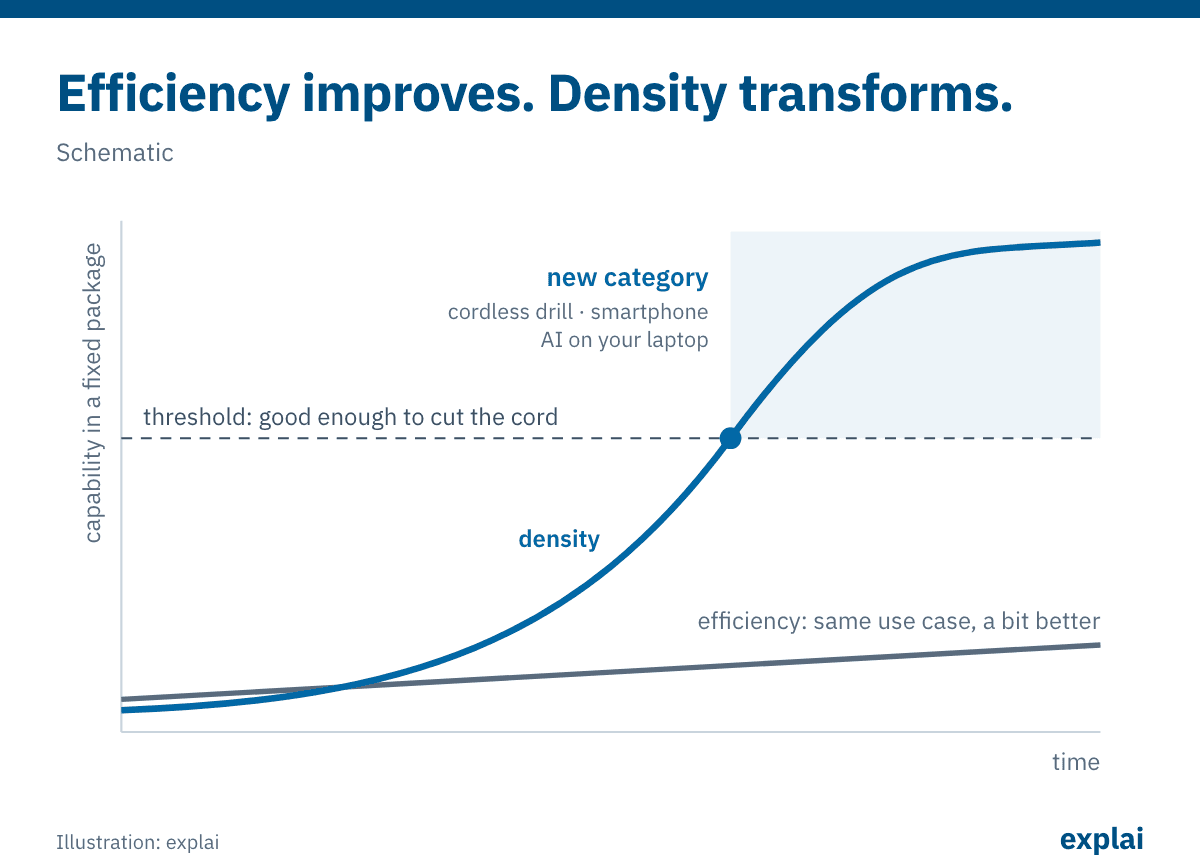
Efficiency — useful output over input — optimises within an existing use case: a more efficient engine, leaner code. Density, in contrast, is quantity per unit of a constraint that matters more for the use case: mass, volume, parameter count.
Power Density
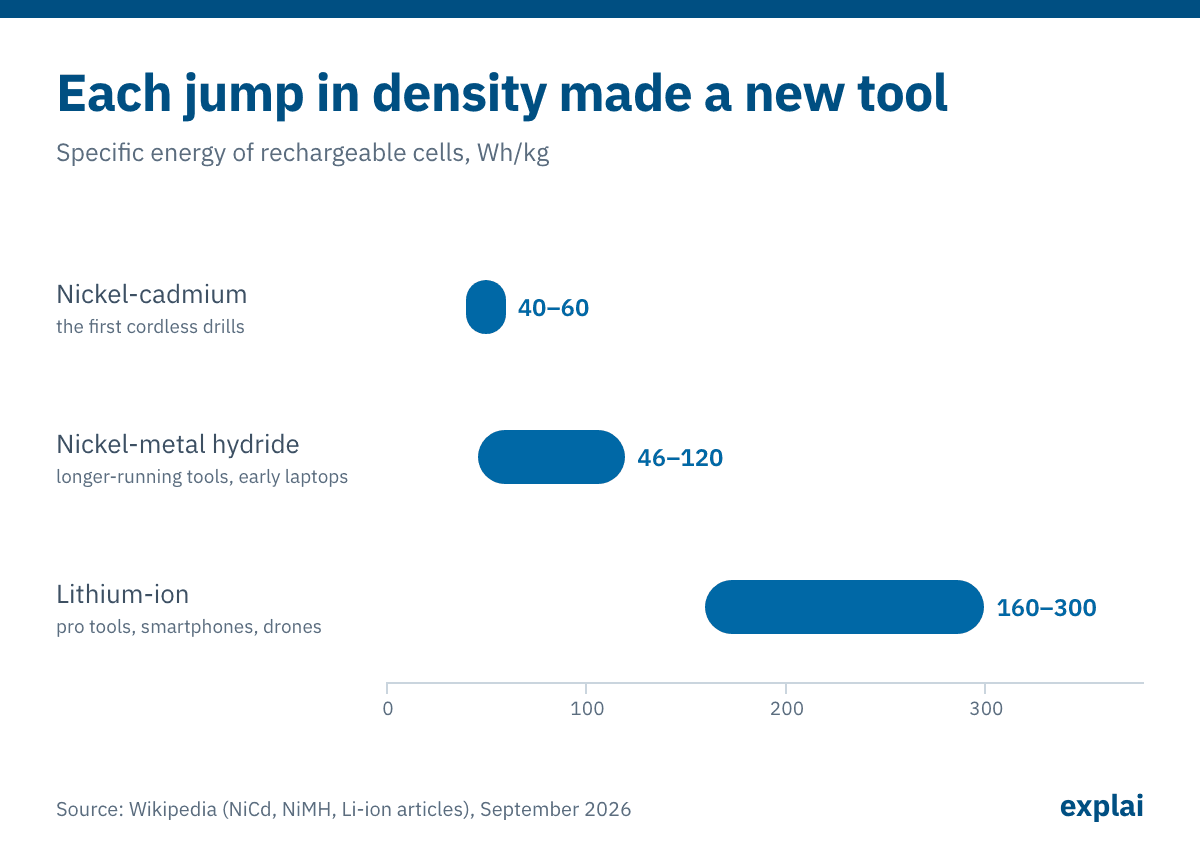
Battery energy density climbed from nickel-cadmium to nickel-metal hydride to lithium-ion. Each jump didn't make cordless tools cheaper to run; it made new tool categories possible. Rare-earth magnets and tighter tolerances made electric motors for handheld tools and drones possible. The path from the steam engine via the turbodiesel to the small combustion engine enabled new uses: from the steam locomotive via the car to the handheld chainsaw.
None of this came from tuning the old design harder alone. It also took other levers: purer copper lets windings carry more current; heat-treated alloy steel carries more torque for less mass; and modern mass production, anticipating demand from the new categories, brought former "space tech" such as advanced battery cells down to a fraction of its price.
Density and Utility
Density improves continuously, just like efficiency. Its units — watt-hours per kilogram, watts per kilogram — make its real-world impact easier to see than the percentages of efficiency. What doesn't improve continuously, in contrast, is utility: the value a product has for the person using it, where they use it. That is where the leap happens:
Andreas Stihl's first petrol chainsaw, the 1929 Type A, weighed 46 kg and needed two people to operate it. His BL of 1950, at 16 to 19 kg depending on the source, was the first Stihl petrol chainsaw one person could carry into the forest. That was the revolution. Since then, progress has been evolutionary: the Contra of 1959 weighed 12 kg, and today's MS 500i delivers 5 kW at 6.2 kg. Specific power rose steadily, from about 0.1 to 0.2, 0.4 and 0.8 kW/kg; utility jumped once.
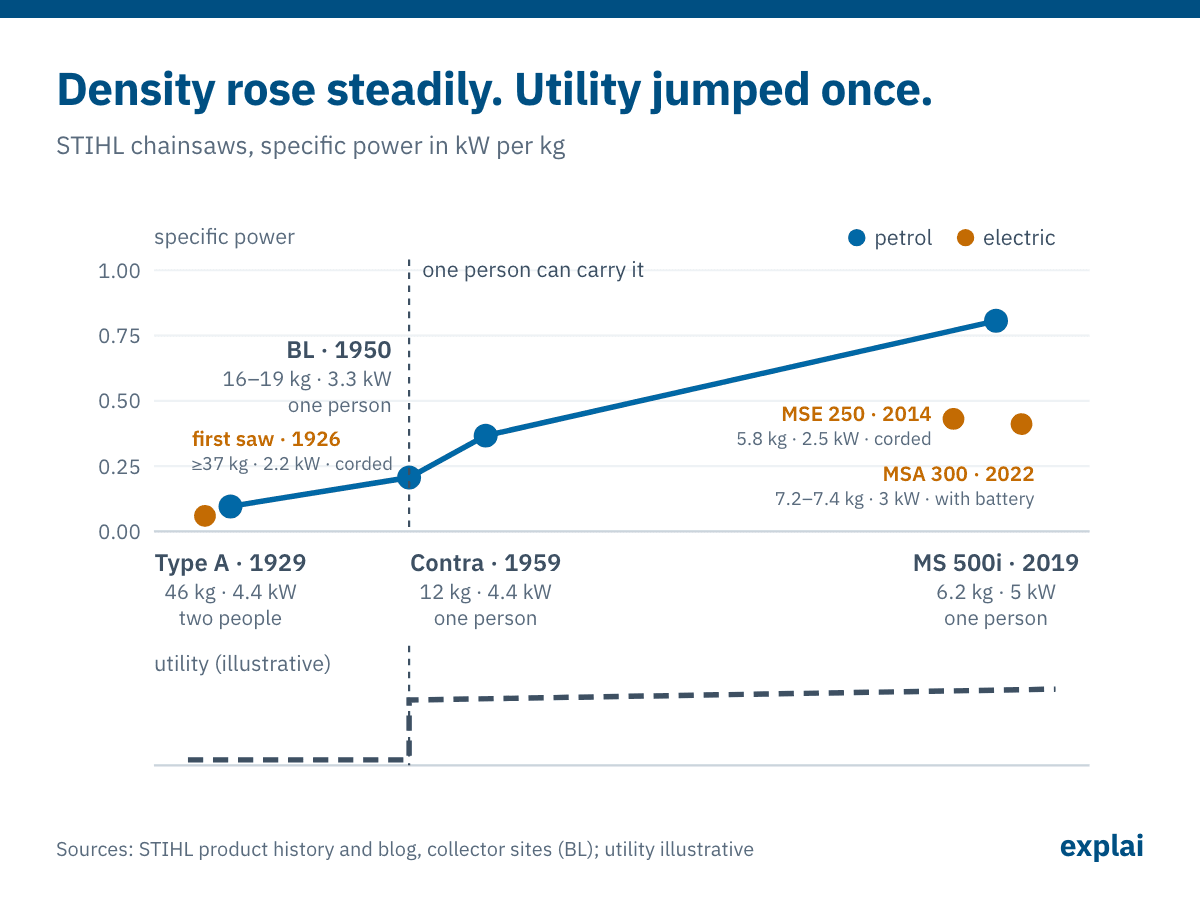
The story has since come full circle. Andreas Stihl's very first saw was electric, corded and so heavy that two people had to operate it. Petrol won because only a fuel tank held enough energy in a portable package one person could carry. Batteries now do too: Stihl sold its first battery chainsaw in 2010, and its MSA 300 delivers 3 kW at 7.2 to 7.4 kg including the battery, roughly where petrol saws stood in 1959. The chainsaw is turning into a battery-powered tool, just like my drill.
Utility depends on the job. Losing the cord matters less next to a socket than on a roof or a scaffold. Local AI works the same way: a model on your laptop is worth most when your data is sensitive and already sits there.
Information Density
I don't think density stops at materials. Information is another "material" being condensed.
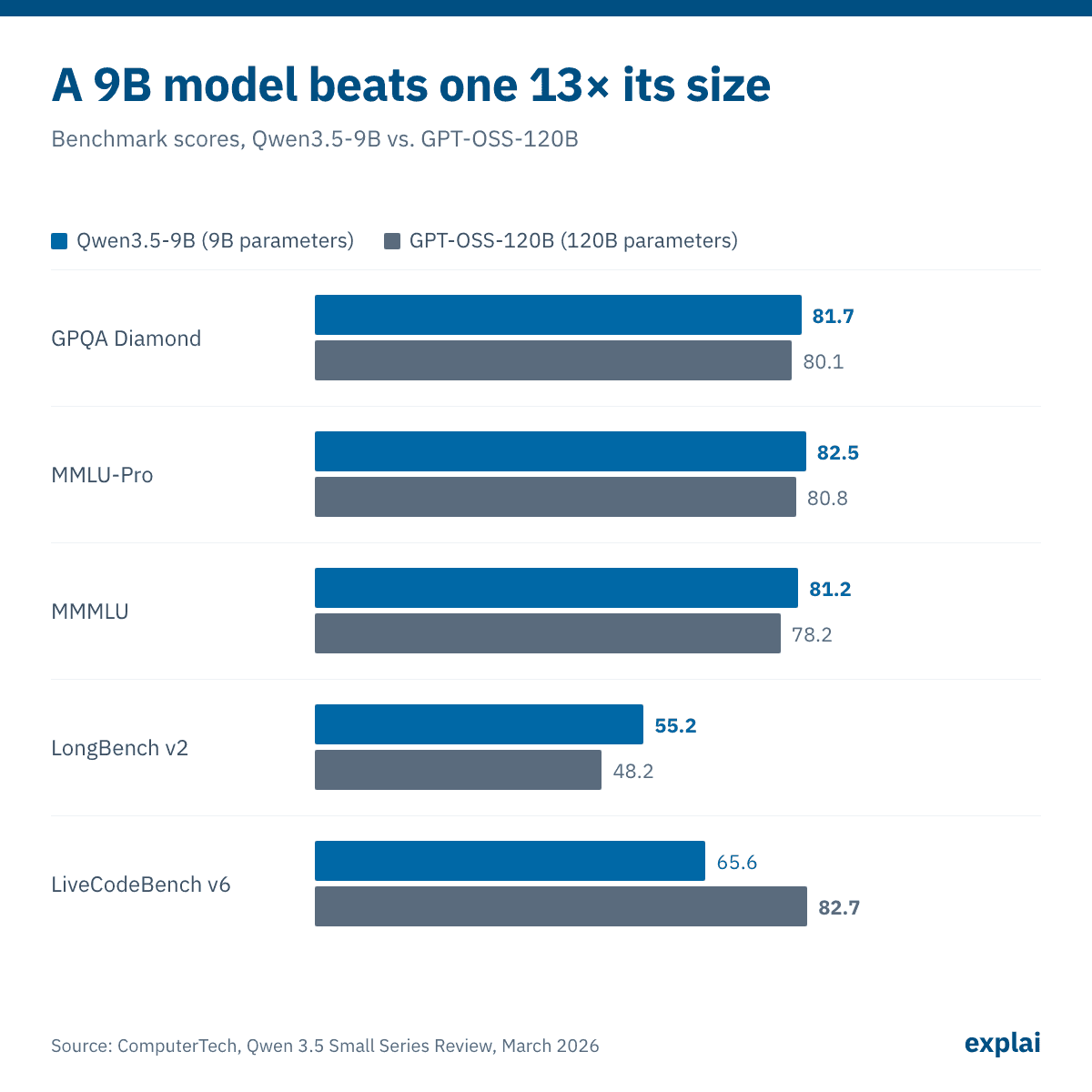
After all, language models are getting denser, not just better. Alibaba's Qwen3.5-9B, released in March 2026, beats OpenAI's GPT-OSS-120B, a model thirteen times its size, on reasoning (GPQA Diamond, 81.7 vs. 80.1) and long context (LongBench v2, 55.2 vs. 48.2). It isn't a clean sweep — GPT-OSS-120B still wins at coding (LiveCodeBench v6, 82.7 vs. 65.6) — but a model that runs on a laptop can now beat one that needs data-centre GPUs on most of what people ask a model to do.
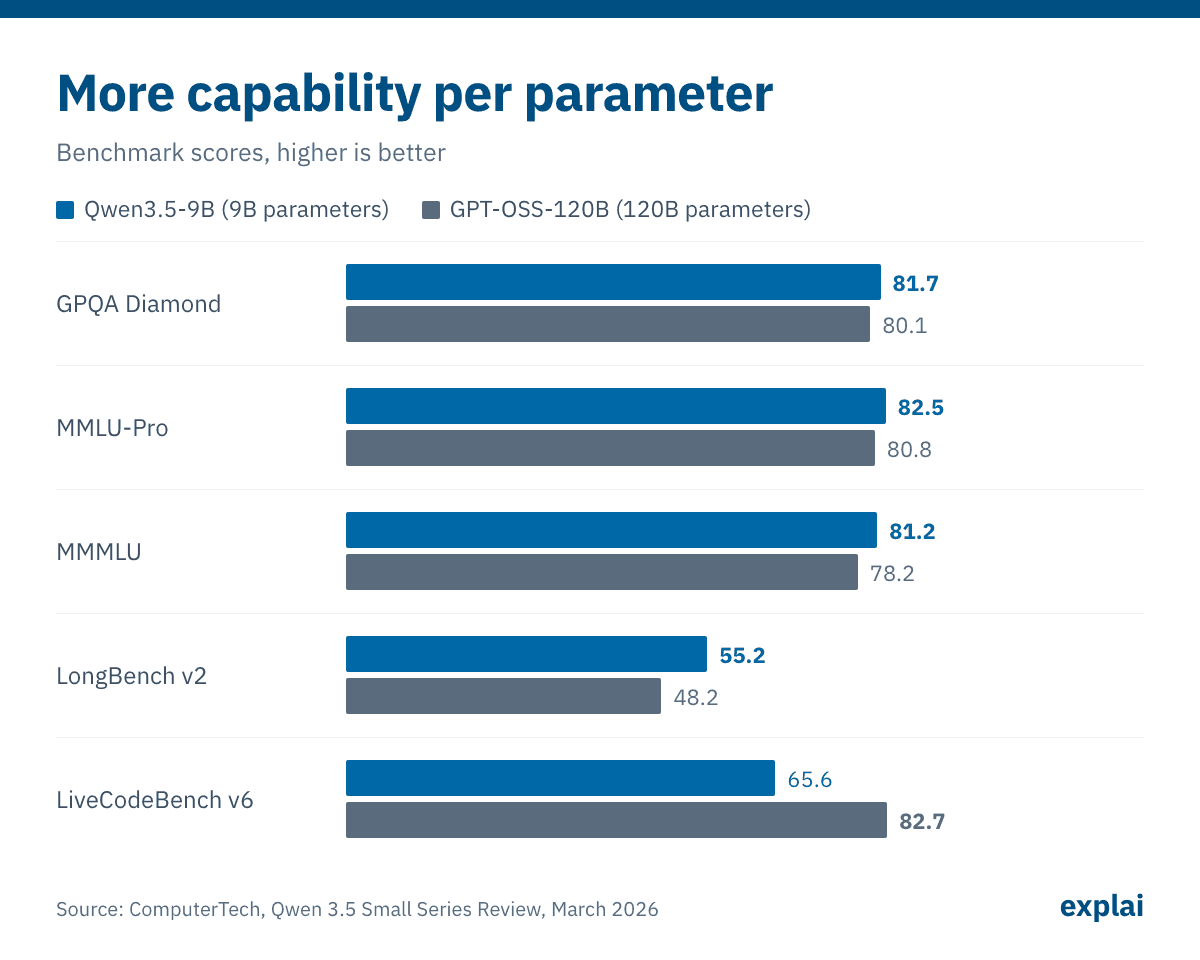
The levers mirror copper, steel or improved manufacturing: better-prepared training data, better architectures, better training algorithms, and, among many other advances, compression such as quantization and distillation.
Compute Density
Chips are the other half. Rising transistor density and performance per watt — the heirs of Moore's Law — let the NPUs and GPUs in ordinary laptops and phones do what recently required a data centre. This, combined with the denser language models, is a cordless-drill moment for AI.
Density on Your Desk
So why do we still assume AI inference — and with it our data — belongs in someone else's data centre, perhaps on another continent or in a country with a questionable legal system?
Much everyday AI work — drafting, coding help — doesn't need a hyperscale cluster once the model fits on the device in front of us. Word processing and spreadsheets took the same path from mainframe to desktop, and I am confident that a real share of AI inference will follow. (Training is different: it needs huge resources and will stay in data centres.)
Run inference on your own device, and you stop worrying about where your sensitive data goes — compliance suddenly looks far less daunting — and about when your next token limit forces a coffee break, or whether you can still afford that coffee.
One example is Kind, the desktop AI app by Synsira: it lets you ask questions across your own text, images and videos, and its Local edition guarantees that your data never leaves your Mac or Windows PC.
At explai, we are cutting the cord as well: we are building a desktop app that runs your data analytics entirely locally. Stay tuned...