

The challenge
The story started with a common problem: one of our clients was receiving data from their end customers that was not always clean or in the expected format.
When an issue appeared, it triggered a chain of back-and-forth that took days and involved several teams:
End Customer → Customer Service Team → Analytics Team → Customer Service Team → End Customer
This chain repeated every week. The customer service team had to understand what was wrong before they could explain the issue to the end customer. But many of them didn't have a data background. The analytics team, meanwhile, had to step in to investigate issues that often looked minor from the outside. That pulled them away from product analytics, where they were needed, and into customer service work.
The result:
- More pressure on the customer service team
- More dependence on the analytics team
- More back-and-forth with end customers
- Delays before the data could be used for insights
We realized that the real gap wasn't just data quality. It was data knowledge.
The approach
Business data contains knowledge that isn't visible in standard metadata. Knowing that a column contains strings or numbers isn't enough. Someone working with the data also needs to understand:
- What does this field represent?
- What should normally be in it?
- How does it relate to other data?
- What do the values mean?
- What format is expected?
For an experienced data person, much of this knowledge is implicit. For someone new to the data, building that understanding can take weeks or months.
With explai, this knowledge-building doesn't become a separate onboarding project. It happens as part of uploading the data.
When data is uploaded, explai automatically analyzes it and starts building the data knowledge needed to understand and work with it. The user doesn't need to prepare a separate knowledge package or spend weeks explaining the data first.
What we built
We added intelligence directly to the data upload process. As data comes into explai, the agent builds knowledge from both the structure and the content of the data. This goes beyond traditional metadata such as data types, data formats, sample values, column names, and table schemas. explai also looks at the meaning and relationships within the data to build a deeper understanding of how it can be interpreted and used.
This gives explai a richer understanding of the data from the beginning. It can surface:
- Whether incoming data matches the expected structure
- Missing or unexpected information
- What different fields represent
- How different pieces of data relate to each other
- Knowledge that a user might need but would not necessarily know to provide
There is no separate phase where someone has to manually document the data before the system can start working with it.
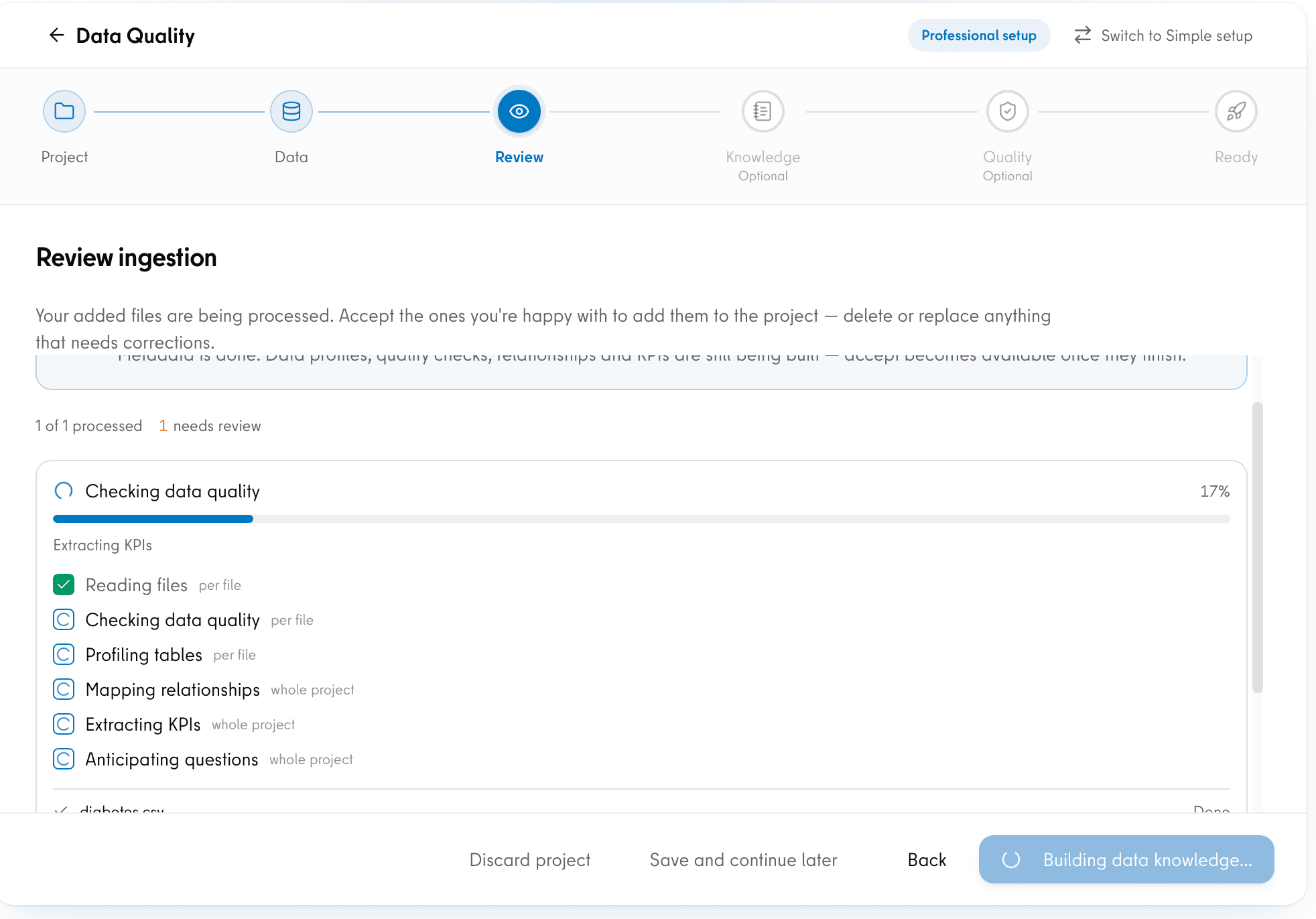
Here is what this looks like for a sample file. While the data uploads, explai reads the file, checks data quality, profiles the tables, maps relationships, and extracts KPIs:
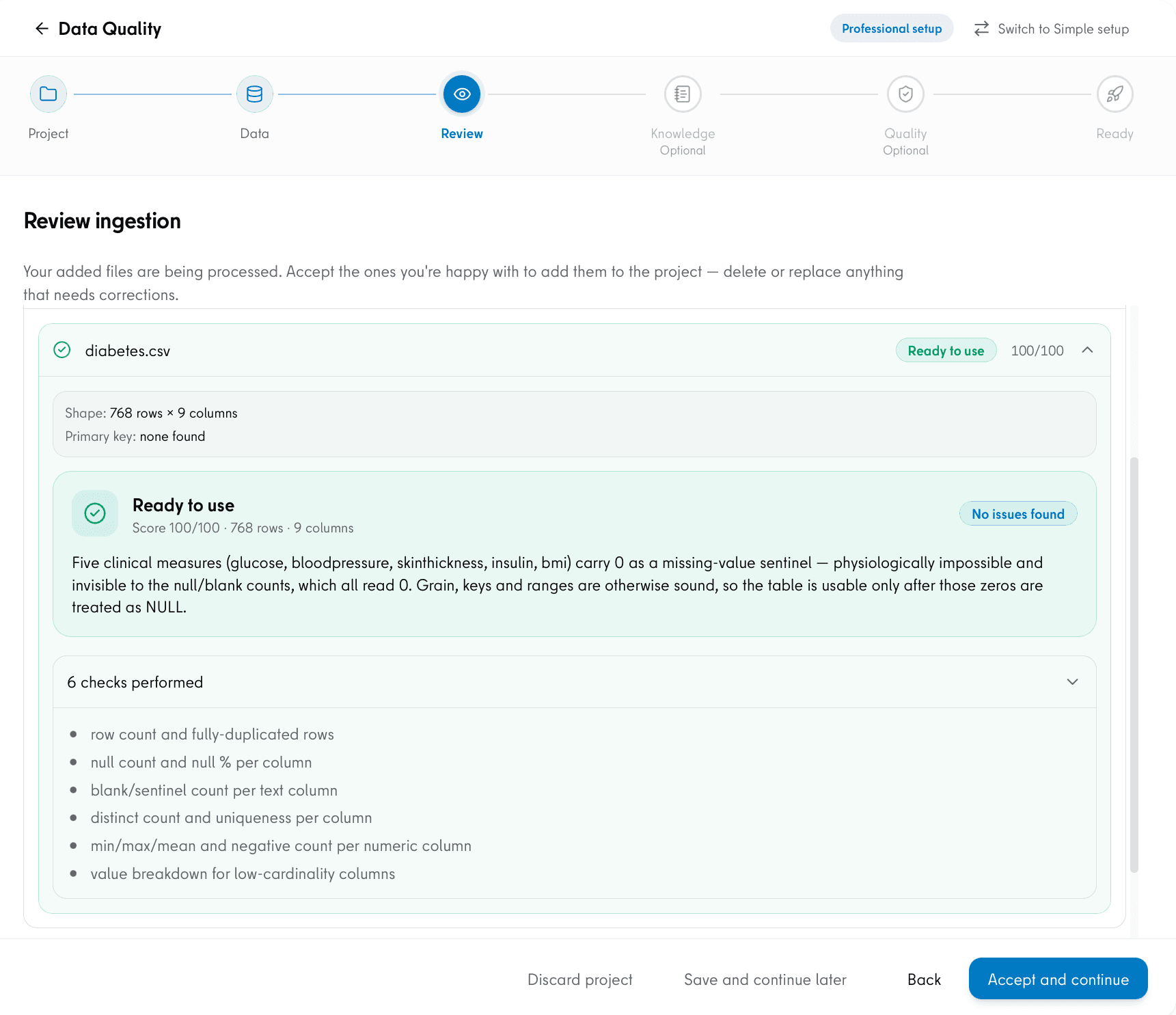
When the check finishes, explai flags that five clinical columns use 0 as a hidden missing value, an issue that is easy to miss:
Human control
Automatic knowledge generation doesn't mean the user loses control. Users can:
- Review the knowledge created by the agent
- Correct or update it
- Add information where needed
- Decide what the agent should use
The agent does the initial discovery work. The user remains in control. This is particularly valuable for people who don't have a data background. Instead of starting with a blank page, they get an intelligent starting point they can review and refine.
Why it works
The key insight is this: Data understanding becomes part of data upload. Instead of treating knowledge creation as a separate task, explai combines the two. That removes work that would otherwise require manual investigation, documentation, and knowledge transfer. The result is:
- Less manual data preparation
- Less dependence on the analytics team
- Faster identification of potential data issues
- Less back-and-forth between teams
- A faster path from uploaded data to useful answers
And the benefit goes beyond data quality. The knowledge created during upload becomes a foundation for the agent's future work. It helps explai answer questions that require understanding what the data means, not just retrieving a value from it.
From one project to a standard capability
What started with one client problem became an important product insight:
Fast onboarding requires the system to understand the data — not just connect to it.
We incorporated this insight into explai as a standard capability and rolled it out to other enterprise client projects, including Cockpit Launch. Today, the process is straightforward:
Upload your data. Then:
- explai analyzes the data
- explai generates the data knowledge
- The user reviews and refines it
- The agent reuses it for later questions
What used to require a separate phase of data understanding and knowledge transfer now happens during upload.